
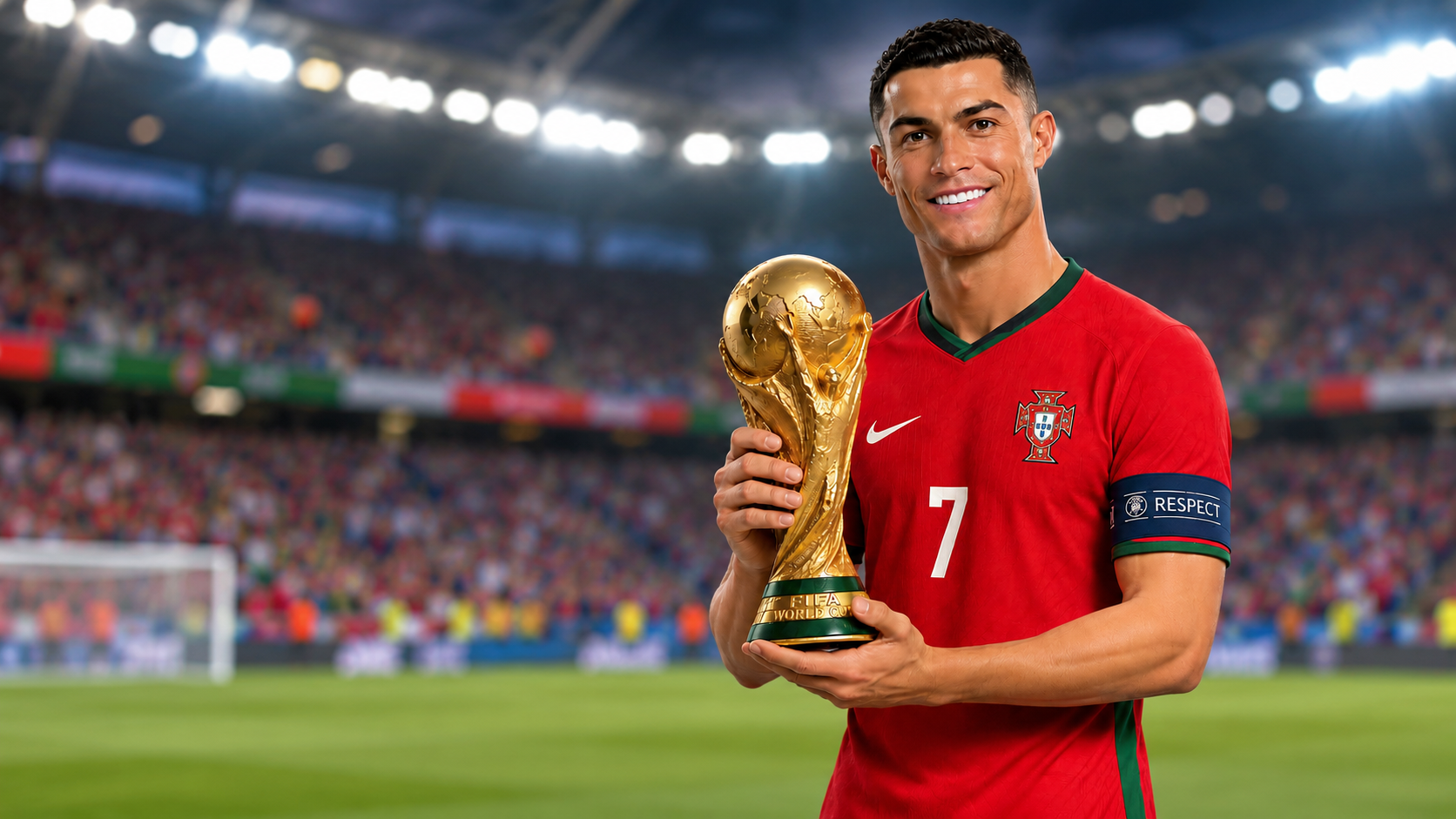
The Cristiano Ronaldo biography is one of those sporting stories that almost sounds too neatly written. A boy from a small Portuguese island grows up to become one of the most recognisable athletes on the planet, breaks records across several countries and spends more than two decades making defenders, goalkeepers and football statisticians work overtime.
But the interesting part is not simply that Ronaldo became famous.
It is how he got there, what he had to change along the way and the extraordinary ability to reinvent himself without losing the competitive personality that made him famous.
The Boy From Madeira
Cristiano Ronaldo dos Santos Aveiro was born on 5 February 1985 in Funchal, Madeira, Portugal.
Madeira is an Atlantic island, far removed from the traditional centres of European football. His childhood was financially modest, and he grew up with three siblings.
His name has an interesting story. His father admired American actor Ronald Reagan, who later became president of the United States, and Ronaldo was named partly in his honour.
It is a curious little detail in the life of a footballer who would eventually become a global celebrity.
At a young age, football became the centre of his ambitions. He joined Sporting CP's youth system at approximately 12, leaving home for Lisbon to pursue his development.
Imagine being that young and having to leave the familiar surroundings of your family to chase a dream that offers absolutely no guarantee of success.
I think this is one of the most important parts of the Cristiano Ronaldo biography. His professional journey began with a decision that demanded sacrifice before fame, money or trophies were anywhere in sight.
A Medical Scare At 15
One of the lesser known episodes in Ronaldo's early life involved a heart condition that required medical treatment.
At approximately 15, he underwent a procedure to address a racing heartbeat. The treatment was successful, allowing him to resume his football development.
It is a reminder that even a seemingly unstoppable athlete can encounter circumstances that threaten to change everything.
Sporting CP And The Manchester United Opportunity
Ronaldo made his senior debut for Sporting CP in 2002.
His performances attracted attention, and a friendly match against Manchester United in 2003 became a major turning point. United players were reportedly impressed by the young winger, and the club signed him that year.
He was 18 when he arrived in England.
At Manchester United, he initially became known for his tricks, pace, dribbling and ability to take on defenders. But his game gradually changed.
He became more efficient in front of goal, developed his aerial ability and turned himself into a forward capable of deciding major matches.
Under Sir Alex Ferguson, Ronaldo won three Premier League titles and his first UEFA Champions League trophy in 2008.
That same year, he won his first Ballon d'Or.
The Madrid Transformation
In 2009, Ronaldo joined Real Madrid in a transfer that changed the financial and sporting landscape of football.
He eventually became the club's all-time leading goalscorer, recording 450 goals in 438 competitive appearances.
Think about that for a moment.
Four hundred and fifty goals for one club.
His time at Madrid produced four Champions League titles, two Spanish league titles and four Ballon d'Or awards.
The rivalry with Lionel Messi at Barcelona became one of the defining sporting narratives of the modern era.
Every season seemed to produce another argument about who was better. Every goal became evidence in somebody's football courtroom.
And neither man seemed particularly interested in making the argument disappear.
Juventus, Manchester United And Saudi Arabia
In 2018, Ronaldo moved to Juventus, winning Serie A titles and continuing his remarkable goalscoring record.
He returned to Manchester United in 2021 before leaving in 2022.
In December 2022, he joined Al Nassr in Saudi Arabia, opening a new chapter in his career and bringing enormous international attention to the Saudi Pro League.
Some people interpreted the move as a departure from Europe's elite football environment. Others saw it as an opportunity to develop a different football market.
Either way, his presence helped bring unprecedented international attention to Saudi club football.
The Records That Tell Only Half The Story
Ronaldo's achievements include five Ballon d'Or awards, five Champions League titles and the men's international records for appearances and goals.
UEFA records also include 140 Champions League goals, 183 appearances in the competition and 17 goals in a single Champions League season.
He became the first player to score at six men's World Cups.
But the numbers do not fully explain his influence.
His athletic preparation, discipline, branding and ability to maintain commercial relevance have made him an unusually powerful figure in modern sport.
He has become a business in his own right, with a global audience that extends far beyond football.
The Personality Behind The Number 7
Ronaldo is not universally loved.
His confidence, competitive intensity and visible frustration have attracted criticism as well as admiration.
Some supporters see arrogance where others see self-belief. Some interpret his public celebrations as showmanship, while others see the personality of someone who refuses to hide his ambition.
I find that tension interesting because sporting icons rarely become cultural phenomena by pleasing everybody.
Ronaldo has always understood that being excellent is one thing. Remaining visible, relevant and commercially attractive is another.
And he has managed both.
What His Career Really Teaches Us
The most valuable lesson from the Cristiano Ronaldo biography is not that everybody should attempt to become the next CR7.
That would be a rather unrealistic career plan.
It is that talent needs structure. Ambition needs consistency. Reinvention requires the willingness to accept that the skills that made you successful yesterday may not be enough tomorrow.
Ronaldo evolved from a winger into a prolific goalscorer. He changed leagues, teammates, tactical systems and countries while maintaining a remarkable level of performance.
Now, as his international career closes, his story offers a different question.
Can a person who has spent most of their adult life pursuing one enormous ambition learn to enjoy a life that is not organised around it?
That may turn out to be the most interesting chapter of all.
- Are you interested in learning how to write professionally and earn money as a writer and content creator? Contact Tolani Talks Writing Desk today to start your writing journey immediately.
- Need a professional website in 72 hours? Contact Tolani Talks Web Studio.
- Do you need a professional writer in 72 hours? Contact Tolani Talks Writers.
- If you have an article, opinion piece, event or news story you would like published, Tolani Talks would love to hear from you. Get in touch.
- Advertise With Us