
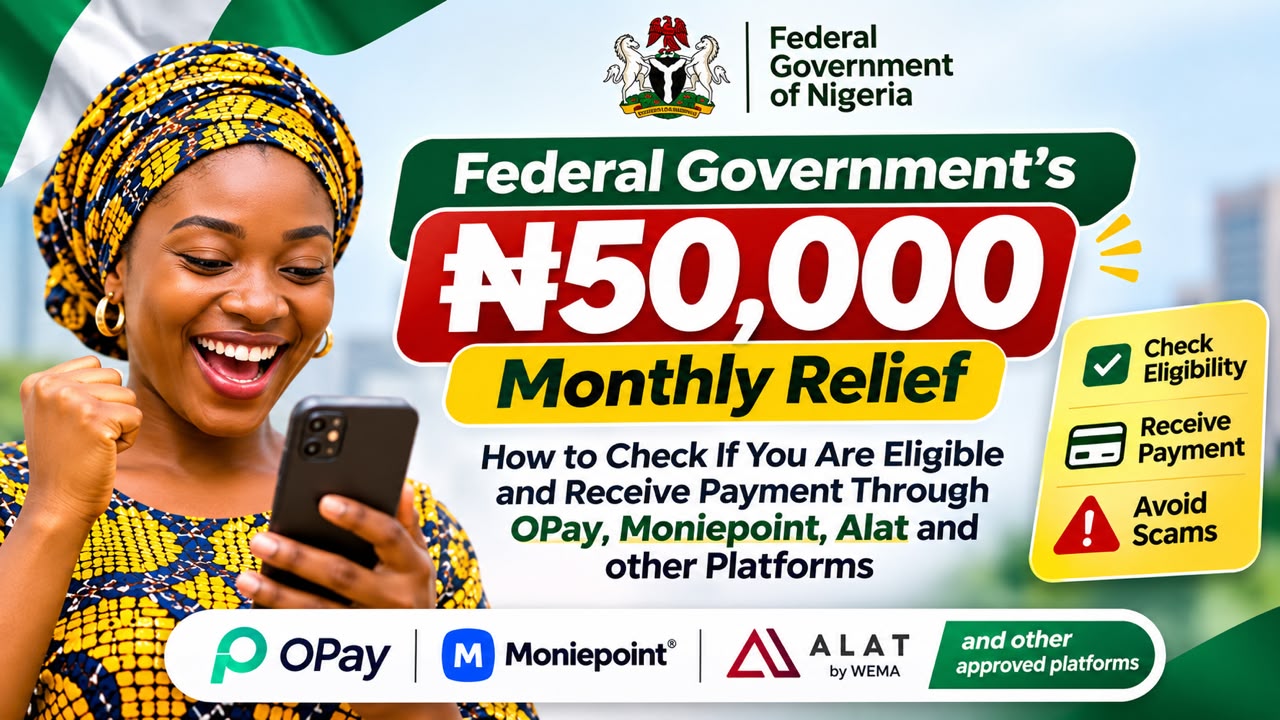
I knew something interesting was happening when conversations about OPay started appearing alongside questions about the Federal Government's latest ₦50,000 cash support. Suddenly, people who ordinarily open their financial apps to transfer money, buy airtime and pay bills were checking their homepages for something rather different: a government relief notification.
The Federal Government OPay grant has become one of Nigeria's latest trending financial stories, but there is considerably more happening here than a fintech application displaying a government payment notification.
The programme is real. The money is intended for vulnerable households. The government has announced the commencement of payments, and OPay is one of five approved financial service providers participating in the distribution.
However, there is a question I think deserves more attention than the excitement surrounding the money: who actually gets selected, how does the government decide, and what happens to the millions of Nigerians who need assistance but do not receive a notification?
Let me unpack what the stakeholders have said, and what Nigerians are actually discussing.
The Government's Explanation: Why ₦50,000?
On 30 October 2026, the Federal Ministry of Humanitarian Affairs and Poverty Reduction announced the commencement of the National Emergency Relief and Stabilisation Intervention, popularly known as NERSI.
The announcement was made by the Minister of Humanitarian Affairs and Poverty Reduction, Dr Bernard Doro, on behalf of the Federal Government.
According to the minister, the intervention is designed to provide immediate financial assistance to vulnerable Nigerians facing rising food prices and the increasing cost of essential goods.
The government says eligible beneficiaries will receive ₦50,000 monthly to help meet basic household needs and ease the pressure of living costs.
I find the choice of timing significant. Nigerian households have been navigating difficult financial decisions, from food purchases and transportation to rent, school expenses and everyday essentials.
For a household already struggling to stretch its income, ₦50,000 can make a practical difference. It may cover groceries, contribute towards electricity or transport expenses, or provide temporary breathing room.
But I would not confuse temporary relief with economic recovery. A cash transfer can help a household survive a difficult period. It does not, by itself, reduce food inflation, create employment or permanently improve purchasing power.
That distinction matters when assessing what the government is promising.
Why OPay Is Involved
Now, here is where the story becomes particularly interesting.
The government is not distributing the money exclusively through OPay. It has appointed five digital financial service providers to facilitate the payments.
They are:
ALAT by Wema Bank
MoMo Payment Service Bank
NairaGram
OPay
Moniepoint
The arrangement is intended to allow selected beneficiaries to receive their money directly through a financial account or mobile wallet.
The government says beneficiaries will receive an SMS from an approved provider requesting their consent before the payment is made.
In other words, OPay is a payment channel, not the government agency responsible for deciding who deserves the money.
I think this distinction is important because the online conversation has increasingly placed OPay at the centre of the programme.
The fintech company is the visible platform for many users, but the responsibility for beneficiary selection belongs to the government and its social protection programme.
The Ministry says beneficiaries are selected using verified national identity records and the National Social Register.
OPay's Own Explanation
OPay has also stepped forward to address the growing questions from its customers.
In its public clarification on 3 November, the company explained that selected customers would see a pop up notification on the OPay application homepage.
Customers who see the notification are expected to open it and follow the instructions.
But the company made another important clarification: it does not determine who qualifies for the government intervention.
OPay also explained that customers who do not see the notification have not been selected in the current eligibility check.
The company directed people with questions about their selection to the NERSI support line rather than its own customer service team.
It also warned against fraudsters, emphasising that it would never request a customer's PIN or one time password to process the government payment.
I think OPay's clarification was necessary. When a government programme becomes accessible through a familiar commercial application, customers can easily assume that the company controls the entire process.
It does not.
The government determines eligibility. The approved providers facilitate payment.
What Nigerians Are Actually Saying
This is where the story moves beyond the official announcements.
I have been particularly interested in the questions circulating around the Federal Government OPay grant because they reveal a different side of the intervention.
For some Nigerians, the first reaction is excitement. ₦50,000 is not an insignificant amount for someone dealing with immediate household expenses.
For others, the immediate question is much simpler: where is my notification?
The OPay clarification has encouraged customers to check their application homepages, while the programme's USSD arrangements have generated further questions about how people can establish their eligibility without relying on a smartphone.
There is also a growing concern among people who have checked and received a notification that they are not currently selected.
A statement circulated by the Youth Economic Intervention and De-radicalisation Programme advised people who saw a NOT SELECTED result to remain patient and await possible subsequent batches. Importantly, that advice did not guarantee that everyone would eventually be selected.
I would not dismiss the frustration behind these questions.
Imagine hearing that the government has commenced a ₦50,000 relief programme, watching people discuss notifications online and then discovering that your own account has nothing.
For someone experiencing genuine financial hardship, that can be disappointing.
Another important conversation concerns how the government identifies vulnerable households. Nigerians want to understand whether the selection records accurately reflect present economic circumstances, particularly when household income and living conditions can change.
There are also legitimate questions about the handling of personal information. The programme involves national identity records, phone numbers and the transfer of beneficiary information to payment providers.
The government says the information is protected under the Nigeria Data Protection Act 2023. However, public confidence will depend not only on assurances but also on clear explanations of how the information is used and protected.
I would describe the public reaction as a mixture of hope, curiosity, disappointment, scepticism and practical questions. I have not found a representative survey that establishes the proportions of Nigerians holding each position.
The ₦50,000 Question: Who Actually Qualifies?
According to the Ministry's programme information, beneficiaries are selected from the National Social Register and verified national identity records.
This is not an open registration exercise where anyone can submit a form and automatically qualify.
The government says people cannot pay to be added to the list, and there is no authorised agent who can secure selection.
If you are selected, you should receive an SMS from one of the approved providers requesting consent.
For OPay customers, the company has also directed users to check their app homepage or use the official USSD channel.
The programme website lists 95520# for OPay.
The other participating providers also have their respective USSD channels, making it possible for people without smartphones or mobile internet access to check their status.
The programme is being rolled out in phases, and not everyone will receive a notification at the same time.
What About Scammers?
I would not discuss a government payment programme in Nigeria without discussing the people who see financial hardship as a business opportunity.
Whenever money is announced, somebody somewhere suddenly becomes a government agent, registration consultant or beneficiary-list administrator.
The NERSI website is explicit: the programme is free.
Nobody should demand money to register you, unlock your payment or move your name higher on a beneficiary list.
Do not disclose your PIN, OTP or password. Do not follow suspicious links or download unofficial applications.
The official programme helpline is 0700-022-2222.
If you receive a suspicious message, verify it through the official government portal before responding.
Is This Relief Or A Long Term Solution?
I think this is the bigger conversation.
The Federal Government is presenting NERSI as a response to economic hardship, and the intention to provide direct assistance to vulnerable households is understandable.
But I would also like to see the government communicate more clearly about the programme's coverage, the number of beneficiaries, the total funding commitment, the verification process and the results of each payment cycle.
How many households will receive support? How will excluded households be assessed? How will the government demonstrate that the money reached the intended beneficiaries?
These are not unreasonable questions. They are the questions that should accompany public spending.
A successful social intervention should be judged not simply by the number of announcements or the excitement surrounding a mobile application, but by whether the right people receive meaningful support.
For now, the Federal Government OPay grant has created an unusual national moment: millions of people are looking at a financial application and wondering whether relief has finally found their phone number.
I think the government has an opportunity to make this programme count. But the real success story will not be the notification appearing on a screen.
It will be the household that receives the money, uses it for something essential and experiences a little less pressure because the support actually arrived.
- Are you interested in learning how to write professionally and earn money as a writer and content creator? Contact Tolani Talks Writing Desk today to start your writing journey immediately.
- Need a professional website in 72 hours? Contact Tolani Talks Web Studio.
- Do you need a professional writer in 72 hours? Contact Tolani Talks Writers.
- If you have an article, opinion piece, event or news story you would like published, Tolani Talks would love to hear from you. Get in touch.
- Advertise With Us