
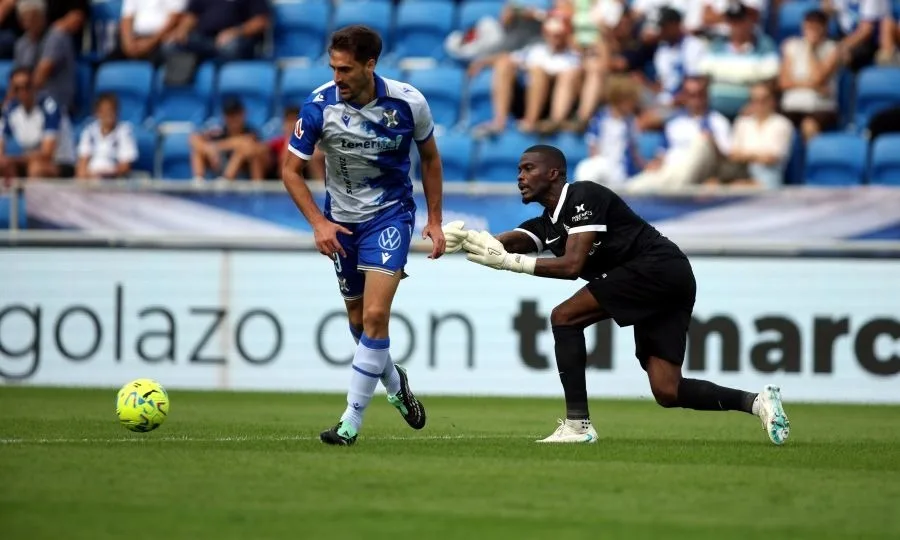
The Football Collision That Ended In Tragedy
I have covered stories where a sporting moment becomes a national conversation, but there are moments when football stops being football altogether. The death of Spanish striker Jesús de Miguel Alameda, following a collision with FC Andorra goalkeeper Jesús Owono, is one of those moments.
Read More: Promote Your Brand on X (Twitter) & Google with Daily Blog Publishing
The 30-year-old CD Tenerife forward died on Tuesday, 3 November 2026, after suffering a serious injury during his team's Spanish second-division encounter with FC Andorra on Monday. His club confirmed the news in a statement released at 8:00 a.m. local time, which was 9:00 a.m. in Nigeria.
What began as a competitive football match ended with an abandoned fixture, emergency medical intervention and a sporting community struggling to process an extraordinary loss. I think the first thing worth establishing is that this was not simply a footballer being substituted after a bad challenge.
De Miguel was involved in a serious on-field collision, required urgent medical attention and was taken to hospital. His condition subsequently deteriorated. The collision happened towards the end of the match at Tenerife's Heliodoro Rodríguez López Stadium.
The score was 2–2, and the game had entered stoppage time when Owono left his goal to challenge for a long ball. The goalkeeper and the Tenerife forward collided during the challenge. De Miguel fell to the ground and required immediate medical attention.
Players from both teams called for assistance as medical personnel entered the pitch. Owono was shown a straight red card. The match was eventually abandoned to allow the emergency response to continue.
From Hospital To A Tragic Announcement
I would not rush past the medical timeline because it matters when reporting a story of this magnitude. Following the incident, De Miguel was taken by ambulance to the University Hospital of Nuestra Señora de Candelaria in Santa Cruz de Tenerife.
Tenerife initially reported that he was in intensive care and stable despite the severity of his condition. An update in the early hours of Tuesday morning indicated that his neurological condition had deteriorated. Then came the announcement nobody wanted.
CD Tenerife confirmed that De Miguel had died on Tuesday morning. The club expressed its grief and extended its condolences to his family, friends, teammates and supporters. The Spanish Football Federation also issued an official statement mourning the player's death.
The federation subsequently postponed the Copa del Rey and Copa de la Reina fixtures scheduled for Tuesday as a mark of respect. A scheduled presentation involving Spain's Under-21 team was also suspended. I find that response significant.
It demonstrates how an individual player's death can reach far beyond the club shirt he wore. The consequences were felt across the wider football calendar.
Who Was Jesús De Miguel?
I think it is important that we do not allow the circumstances of his death to become the only thing people remember about him. Jesús de Miguel was born in Madrid on 21 September 1996. He developed through Spanish football's lower divisions, representing several clubs before establishing himself as a forward capable of scoring important goals.
His career included spells with Leganés, Fuenlabrada, Internacional de Madrid, Unión Adarve, Navalcarnero and Unionistas de Salamanca. His time at CD Castellón proved particularly important. He scored 25 goals for the club across his three-season spell, helping the side secure promotion to Spain's second tier.
He joined CD Tenerife in 2025 and became part of the team that secured promotion back to the Segunda División. The Tenerife striker was 30. His professional journey was still unfolding.
And that is what makes this story especially difficult. There was a football career, a family and a future beyond Monday night's match. The club has also asked the public to respect the family's privacy during this period of grief.
The Other Side Of The Tragedy: Jesús Owono
While the football world mourns De Miguel, another name has become central to the story: Jesús Owono. The 25-year-old Equatorial Guinea international was the goalkeeper involved in the collision. He received a red card during the match, and his name has subsequently become the focus of intense online attention.
I want to make one distinction particularly clear here: a referee's decision to issue a red card is a disciplinary decision made during a match. It is not a criminal conviction, nor does it establish criminal intent. There is a difference between a dangerous challenge, a disciplinary offence, an accident and criminal responsibility.
Those are not interchangeable descriptions. Reports on Tuesday say Owono has faced hostile messages and threats following the incident. Some accounts also report that he has restricted or deactivated his social media presence.
There are reports that he was visibly distressed after the collision and that he remained concerned about De Miguel's condition. FC Andorra has expressed condolences to De Miguel's family, teammates and CD Tenerife. The club's president, Gerard Piqué, also publicly expressed his sorrow.
I find this second dimension of the story particularly troubling. A footballer can be involved in a tragic incident and still be a human being deserving of protection from threats and harassment. Accountability matters.
So does evidence. Online punishment, however, is not a substitute for either.
Football, Safety And The Human Cost
I would not use this tragedy to suggest that every collision in football is preventable. Football is a contact sport, and goalkeepers regularly leave their penalty areas to intercept long passes. But incidents like this should remind clubs, leagues and governing bodies that emergency medical readiness, player welfare and appropriate safety procedures are not administrative formalities.
The public deserves accurate information about what happened. The family deserves privacy. De Miguel's teammates deserve the space to grieve.
Owono deserves not to be subjected to threats while the facts are established. I also think there is a lesson for social media audiences. We are increasingly accustomed to receiving dramatic footage before we receive complete information.
A video can show an impact, but it cannot independently establish intention, medical causation or criminal liability. The Jesús de Miguel death story is heartbreaking enough without embellishment. What I want readers to remember is that De Miguel was more than the footballer involved in a collision.
He was a professional who worked his way through the difficult layers of Spanish football, represented several clubs and reached the second division through years of effort. His death deserves more than a trending hashtag.
And the people left behind deserve something more valuable than internet outrage: truth, compassion and respect.
Read More:
Promote Your Brand on X (Twitter) & Google with Daily Blog Publishing