
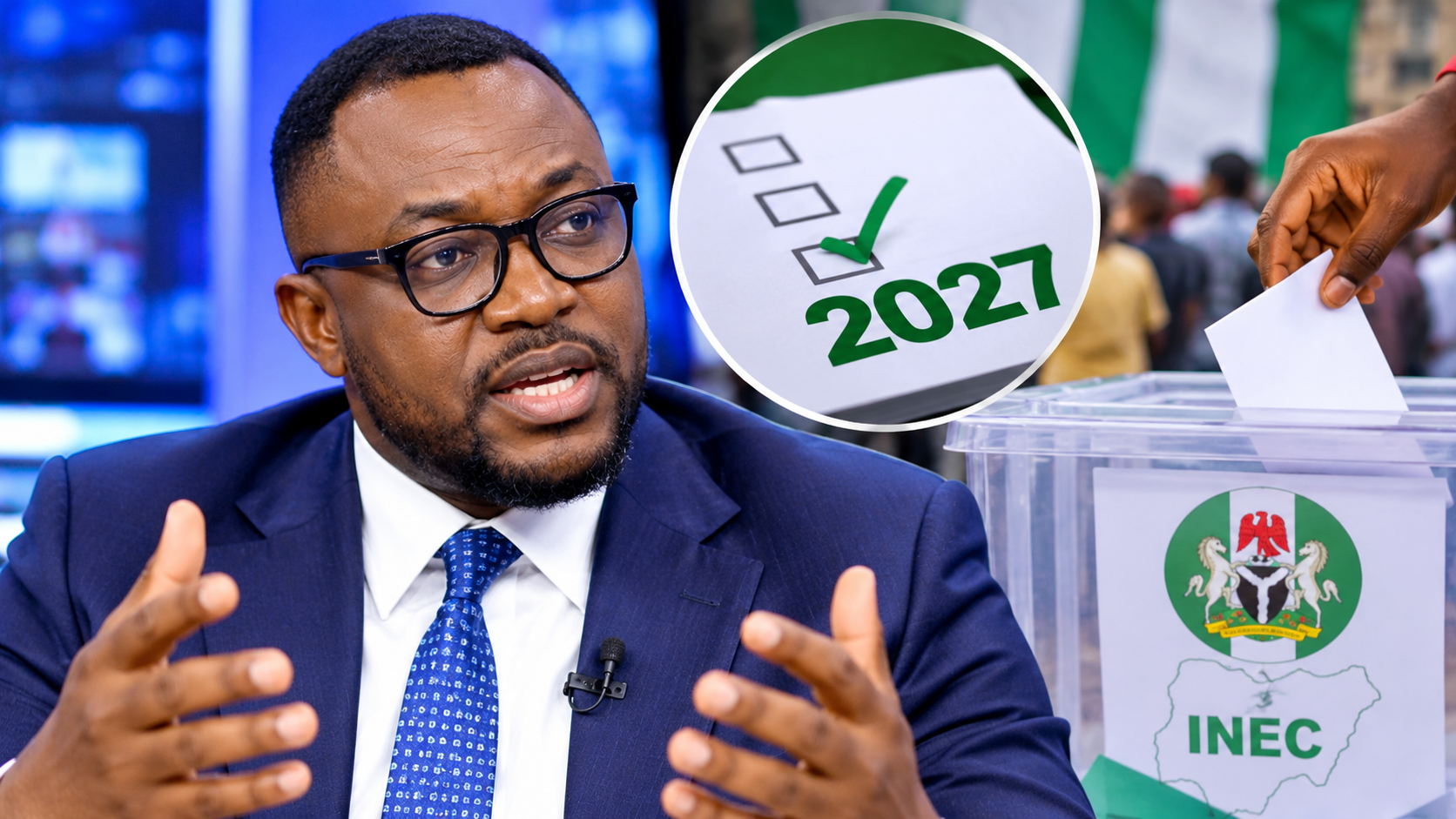
Okinbaloye gave the explanation on Sunday Politics on November 1, following strong reactions to his closing remarks on the Friday edition of Politics Today.
His earlier comments raised questions across the country. Some Nigerians wanted to know whether he was accusing the Independent National Electoral Commission (INEC) or a particular political group of planning to manipulate the next election.
However, the journalist said his warning had been misunderstood. He insisted that his main concern was the need to protect the voters’ register before the 2027 elections.
What Seun Okinbaloye Said About the 2027 Elections
The controversy began after Okinbaloye warned that election manipulation could start long before election day.
During the Friday edition of Politics Today, he argued that Nigerians should not wait until voting begins before paying attention to possible electoral problems.
He said the process of rigging an election could begin months before voters go to the polling stations.
He also warned that the 2027 election could be compromised if the problems surrounding the voters’ register were not addressed.
His statement quickly spread across social media. It attracted reactions from Nigerians who wanted to know what information he had and who he believed was responsible.
Some people understood his remarks as an accusation against INEC or the ruling political party. Others believed he was raising a wider concern about the safety of Nigeria’s electoral process.
Okinbaloye Says His Warning Was Not Against Any Political Party
Speaking on Sunday Politics on November 1, Okinbaloye explained that he had not accused any political party or candidate.
He said his warning did not identify a sponsor or point fingers at a particular political group.
Instead, he said he was drawing attention to concerns about the preliminary voters’ register released by INEC.
He also referred to the commission’s own comments about questionable records found in the database.
His explanation was important because some social media posts had presented his earlier remarks as though he had directly accused President Bola Tinubu and INEC of rigging the 2027 election.
However, a fact-check by The FactCheckHub found that the viral claim was false. Its review of the original broadcast found that Okinbaloye did not mention Tinubu or name any political party in his warning.
Why the INEC Voters’ Register Became a Major Concern
The debate is connected to questions about the accuracy of Nigeria’s preliminary voters’ register.
INEC published the preliminary register online on October 26, 2026. Before then, the commission had displayed the register at registration areas across the country from October 9 to October 15.
During the exercise, some questionable records were identified. Members of the public also raised concerns after screenshots showing unusual photographs attached to voter records began circulating online.
The concerns included suspected AI-generated photographs, duplicate entries and other possible errors.
INEC later confirmed that it was reviewing questionable records and taking steps to correct them.
The commission also stressed that the published register was not the final certified version. It said the review process was meant to help identify and correct errors before the final register was approved.
INEC Reveals How Some Questionable Records Entered the Database
On October 30, INEC’s Director of Information and Communication Technology, Dr Lawrence Bayode, provided more information about the suspected irregularities.
Speaking on Arise Television, Bayode said some registration officers had allegedly used their official login details to introduce questionable records into the database.
He explained that some of the photographs were generated using artificial intelligence, while others came from poor registration practices.
The commission said it had used its Automated Biometric Identification System, known as ABIS, to identify suspicious records.
Bayode’s comments raised further questions about how people with access to INEC’s system could introduce questionable information into the register.
They also increased calls for the commission to investigate the matter and hold anyone found responsible to account.
INEC Says It Has Started Cleaning Up the Register
INEC has said it is working to correct the problems before the final register is certified.
On November 1, the commission’s ICT director said its system had flagged 268 records for further review.
He explained that the commission was examining the records and would remove those confirmed to be invalid.
He also made an important distinction between photographs created entirely by AI and genuine photographs improved with AI tools. According to him, the use of an AI editing tool alone would not mean that a genuine voter should be removed from the register.
INEC has said the final verification, review and data-cleanup process is expected to be completed before the final Register of Voters is certified on December 15, 2026.
Nigerians React to Okinbaloye’s Explanation
Okinbaloye’s clarification did not end the debate.
Some Nigerians supported him, saying journalists and other public figures should be able to raise concerns about the electoral process without being accused of supporting a political party.
Others were not satisfied with his explanation.
Some critics argued that his original warning sounded like a serious claim that election rigging was already taking place. They wanted him to provide more details about the information behind the statement.
The debate also brought more attention to INEC. Some Nigerians argued that the commission should do more to explain how questionable records entered its database and what steps it was taking to prevent a repeat.
The different reactions show how sensitive the issue of election credibility remains in Nigeria, especially with the 2027 general elections approaching.
Why the Voters’ Register Matters to the 2027 Elections
The voters’ register is one of the most important parts of an election.
It contains the records of people who are registered and eligible to vote. It helps determine who can take part in the election and where they are expected to vote.
If the register contains false, duplicate or incorrect records, it could create problems during the voting process.
For example, questionable records could make it harder to protect the system against multiple voting or other forms of electoral fraud if the proper checks fail.
At the same time, genuine voters must not lose their right to vote because of errors in the system.
This is why INEC must carefully check every disputed record, correct confirmed mistakes and explain its findings to the public.
It is also important to understand that finding questionable entries in a preliminary register does not, by itself, prove that the entire 2027 election has been rigged. The commission must complete its checks and provide clear information about what it has found.
The Bigger Test for INEC Before 2027
Okinbaloye’s warning has brought an important question back into public discussion: how can Nigerians trust an election if they are already worried about the records used to organise it?
His clarification makes clear that he was not naming a political party or candidate. His concern was about possible weaknesses in the voters’ register and the need to address them before election day.
But the responsibility to deal with those concerns rests heavily on INEC.
The commission must show that it can identify questionable records, investigate the people responsible, protect genuine voters and prevent similar problems from happening again.
Public Trust Will Depend on What Happens Next
The debate surrounding Seun Okinbaloye’s warning may continue, but the larger issue goes beyond his choice of words.
Nigeria needs a voters’ register that people can trust. Every eligible citizen should be able to vote, and every vote should count.
INEC now has an important task ahead. Its actions before the 2027 general elections will play a major role in shaping public confidence in the electoral process.