
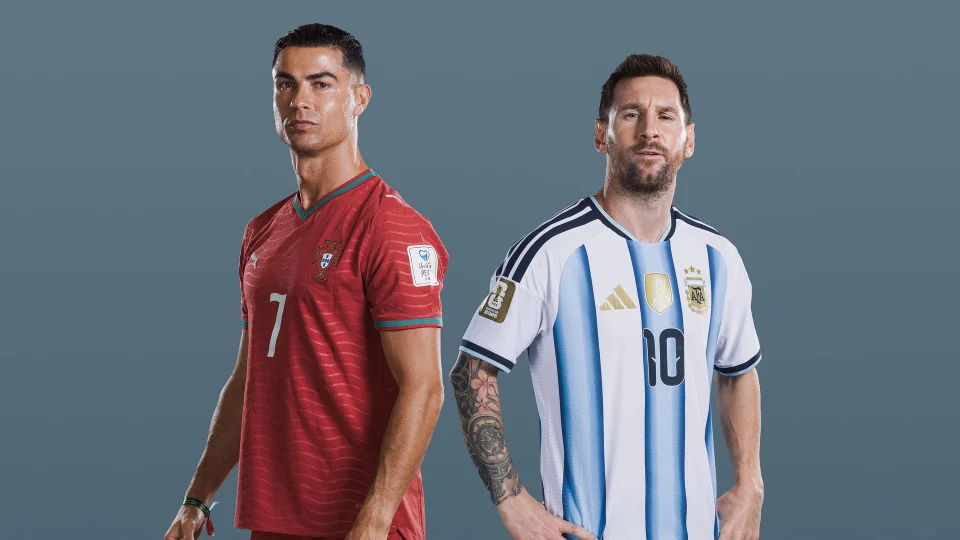
Ronaldo vs Messi is one of those arguments that can turn a perfectly peaceful football conversation into an international diplomatic incident.
Mention one name, and somebody will immediately bring up goals. Mention the other, and another person will produce a list of trophies, assists, dribbles, penalties and statistics that requires its own spreadsheet.
For nearly two decades, Cristiano Ronaldo and Lionel Messi have occupied an extraordinary position in world football. They competed for the biggest individual awards, challenged each other's records and became the defining personalities of an entire sporting generation.
Now, in 2026, their international stories have reached a remarkable point.
Messi announced his retirement from Argentina on 31 August. Ronaldo announced his retirement from Portugal on 5 November.
Both men have stepped away from the national teams that helped define their identities. Neither announcement should be confused with retirement from all professional football.
But before we start arguing about who won the greatest rivalry, I think it is worth understanding how different their journeys actually were.
Two Very Different Beginnings
Cristiano Ronaldo was born on 5 February 1985 in Funchal, Madeira, Portugal.
He left home at approximately 12 to join Sporting CP's youth system in Lisbon. His journey was shaped by early independence, family sacrifice and the challenge of establishing himself away from his home environment.
Lionel Messi was born on 24 June 1987 in Rosario, Argentina.
His childhood football development took a different direction. He joined Barcelona's youth academy after moving to Spain as a teenager, following a family decision that was connected to his treatment for growth hormone deficiency.
The two boys would eventually become football's most recognisable rivals, but their routes to the top were not remotely identical.
Ronaldo's development became associated with athleticism, speed, aerial power and a remarkable ability to adapt his game.
Messi became known for his close control, balance, vision, acceleration over short distances and extraordinary creative instincts.
One became famous for combining athletic power with goalscoring precision. The other developed into a player whose ability to manipulate space seemed almost unfair.
The Great Club Rivalry
Their rivalry became particularly intense during their years at Real Madrid and Barcelona.
Ronaldo joined Real Madrid in 2009. Messi was already establishing himself as Barcelona's defining superstar.
The rivalry was not just about two players.
It was Real Madrid against Barcelona, Madrid against Catalonia, two footballing institutions competing for trophies and millions of supporters choosing their preferred representative.
Ronaldo eventually scored 450 goals for Real Madrid in 438 competitive appearances. Messi recorded 672 goals in 778 appearances for Barcelona.
Both became the leading figures in their respective clubs' modern histories.
Their individual awards were equally remarkable.
Ronaldo won five Ballon d'Or awards. Messi won eight.
That is a substantial statistical advantage for Messi, although the award alone cannot capture every aspect of footballing excellence.
What Their Numbers Say
The comparison becomes particularly interesting when we separate individual records from team achievements.
Ronaldo has won five UEFA Champions League titles and holds the men's international goals record with 146 goals.
Messi has won four Champions League titles with Barcelona and captained Argentina to the 2022 World Cup.
Messi's international trophy collection includes the 2021 and 2024 Copa América titles, the 2022 World Cup and the 2022 Finalissima.
Ronaldo's Portugal honours include the 2016 European Championship and the 2019 and 2025 Nations League titles.
There is also the matter of international appearances.
Ronaldo leaves Portugal with 234 caps. Messi leaves Argentina with 207.
The statistics show two extraordinary players, but they do not provide a mathematical formula for deciding who is greater.
Different supporters value different things.
Some prioritise goalscoring, others playmaking, major trophies, individual awards, longevity or performances under pressure.
And that is why the debate refuses to die.
Two International Farewells
The difference between their international endings is especially interesting.
Messi announced his decision in August after Argentina's 2026 World Cup final defeat to Spain.
He had already achieved his lifelong ambition of winning the World Cup in 2022, alongside the Copa América titles.
His international story had moved from years of disappointment and criticism to a period of extraordinary redemption.
Ronaldo's announcement followed Portugal's elimination from the 2026 World Cup and a difficult period involving the national team.
His departure closes a 23-year international career.
The Portuguese federation has expressed its gratitude and announced its intention to organise a tribute.
The two farewells are similar in one important respect: both men are leaving their national teams after helping redefine what supporters expect from international football.
But the circumstances and emotional journeys are different.
What Fans Are Really Debating
The football community's GOAT debate is unlikely to end because both players have provided enough evidence for different interpretations.
Ronaldo supporters point to his Champions League achievements, goalscoring longevity, success across multiple leagues and extraordinary international scoring record.
Messi supporters point to his playmaking, individual awards, World Cup victory, creative influence and ability to control matches.
In my view, comparing them without considering their different footballing roles is often misleading.
Ronaldo became an exceptional goalscorer who could adapt to different attacking systems. Messi combined goalscoring with an unusually high level of creative responsibility.
They were not identical footballers competing to perform the same job.
They were two different answers to the question of what footballing greatness could look like.
The End Of The Rivalry?
Their retirement from international football does not necessarily end their professional playing careers.
Ronaldo remains with Al Nassr, while Messi continues with Inter Miami.
Their final playing dates remain separate questions.
And that distinction matters because supporters are now watching two careers enter their closing stages rather than two players disappearing from football altogether.
I find myself thinking about something else.
For years, football supporters were able to compare these men while they were actively competing at the highest levels. Their performances became a continuous conversation.
Soon, that conversation will become history.
Future generations will not have to choose between watching Ronaldo and Messi every weekend. They will have to watch recordings, study their records and listen to people explain why one particular season was better than another.
And perhaps that is the most extraordinary achievement of their rivalry.
They did not simply compete for trophies.
They created a footballing argument that lasted an entire generation.